

Here's something most organisations don't want to say out loud: the problem usually isn't capability. It's dynamics.
You have smart people. Qualified people. People who care about their work. They've been to training. They know what good teamwork looks like in theory. And yet — deadlines slip. Conversations go sideways. Decisions stall. Some team members quietly disengage while others overcompensate. You've probably had the offsite, done the icebreakers, maybe even brought in a trainer before. But three weeks later, nothing really changed. And some people quietly stop caring.
This is not a skills problem. It's a team development problem.
Here's what most team programmes miss: they focus on skills without touching the underlying dynamics. Skills training teaches people what to do. Team development work changes how they actually show up with each other.
That gap — between knowing and doing — is where Getting Roots works. That's what Getting Roots is built to do.
What's Really Holding Your Team Back?
You have smart people. Qualified people. People who care about their work.
is built on 22+ years of hands-on experience working with corporate teams across Delhi, Mumbai, Bangalore, Chennai, Hyderabad, Kolkata, and Rajasthan.
We hold a 5.0 rating on Google — and we've earned it by doing one thing consistently: helping teams actually change, not just attend a programme and go back to the same habits.
our High Performance Team Development program
What Is High Performance Team Development?
High Performance Team Development is not just another training intervention. It is an organized, assisted process that focuses on something that most programs overlook: how people truly perform as a unit, rather than as individuals sitting in the same space. relationships, company goals, communication patterns, and leadership behaviours under pressure, that either gradually strengthen or weaken a team, are the true emphasis.
These factors determine whether a team consistently outperforms its opponents or produces mediocre results. It handles conflict without falling apart. It moves fast without losing alignment. And it does all of this consistently — not just when conditions are ideal.
According to our getting roots report, employees working in high-performance teams are five times more productive than those in average teams. And teams aligned around a shared vision improve financial performance by nearly two times. These aren't aspirational numbers — they're what happens when team development is done properly.
At Getting Roots, our High Performance Team Development program is designed to get teams to that level, systematically.
The Team Dynamo: Getting Roots' Approach to Team Development
Every team has visible dynamics — targets, deliverables, and weekly meetings. But underneath that, there are forces that actually run the show: unspoken tensions, unclear roles, trust that was never properly built, and communication that skips the things that matter most.
We call our approach The Team Dynamo — because team dynamics are the deep-rooted forces that give any team its real direction. They either drive the team forward or quietly pull it apart.
Think of your team as a boat. The destination is clear. Everyone's rowing. But undercurrents are pulling in different directions — and no one's talking about them.
Our programme works on both what's visible and what's hidden. Here's what that includes:
- Team SWOT analysis — understanding the group's collective strengths and blind spots, not just individual profiles
- Surfacing real problems — not the ones people are comfortable naming, but the ones actually affecting performance
- Quick conflict resolution — because problems that aren't addressed become culture
- Division of labour clarity — the right people owning the right things, with no ambiguity
- The Johari Window — a tool we use to break down interpersonal barriers and build genuine openness between team members
- Real communication practice — not a communication module, but live, facilitated work on how your team actually talks to each other
- Collective goal ownership — moving people from "my task" thinking to "our outcome" thinking
This is not a theoretical framework. It's a practical, facilitated process built around your team's real situation.
10 Characteristics of High-Performing Teams
Before you invest in building a high-performance team, it helps to know what you're actually building toward. After working with corporate teams across India for over two decades, these are the ten things we see in teams that genuinely perform at the top.
1. Clear, Aligned Goals
Things go more quickly when everyone is aware of the team's goals and why they are important. There is no working against one's own interests or second-guessing. Everybody pushes in the same direction.
2. Open, Direct Communication
People say what they mean. Feedback travels in all directions, not just top-down. Problems get raised early, before they become expensive.
3. Accountability Without Being Chased
In a high-performing team, people own their commitments. The manager doesn't need to follow up three times. Accountability is simply part of how the team works.
4. Adaptability Under Pressure
Indian corporate environments move fast. Plans change. Priorities shift. High-performance teams absorb that pressure and keep moving — without losing trust or momentum in the process.
5. Continuous Learning
These teams don't just debrief when something goes wrong. They actively look for feedback, reflect on what's working, and stay genuinely open to doing things better.
6. Leaders Who Motivate, Not Just Manage
There's a big difference between a manager who tracks tasks and a leader who creates genuine energy around the work. High-performance teams have the second kind — people feel like they're on a mission, not just completing a to-do list.
7. Conflict That Gets Resolved, Not Avoided
Every team has disagreements. The difference is what happens next. High-performance teams deal with conflict directly, create enough psychological safety for honest conversations, and come out of those conversations stronger.
8. Stretch Goals That Create Drive
There's something that happens when a leader sets a goal that feels just slightly out of reach. People rise to it. They stop playing it safe and start pushing themselves. That's the kind of internal drive that no incentive scheme can manufacture.
9. Consistent Vision Communication
Distractions are everywhere. Without a leader who keeps bringing the team back to the "why," people drift. The best team leaders do this constantly — not as a speech, but as a habit.
10. Trust That Goes Both Ways
This one underpins everything else on the list. Trust in high-performance teams isn't assumed — it's built, deliberately, through consistent behaviour over time. When it's there, teams can handle almost anything. When it's missing, even the simplest things become difficult.
High Performance Team Training: How We Build It
Putting talented people in a room together does not make a high-performance team. It just makes a room full of talented people.
Real team performance gets built through a process — one that combines live experience, structured reflection, and deliberate practice over time. At Getting Roots, our team leadership development programme is built on exactly that. No lectures. No slide-heavy presentations. What you get instead is real activity, honest facilitated conversation, and structured reflection that connects directly to the challenges your team faces at work.
The programme focuses on the things that actually drive team collaboration and sustained performance:
Trust and Communication: This is always where we start — because without it, nothing else works. We create the conditions where team members feel genuinely safe to speak up, challenge assumptions, and admit when something isn't working. Without this, every other element of team training is superficial.
Creativity and Problem-Solving: High-performance teams don't just execute — they innovate. We build in activities that push teams to think differently, challenge existing assumptions, and approach problems from new angles.
Leadership Within the Team: Not just the team leader — every person in a high-performance team exercises leadership in their own domain. We develop this capacity across the team, not just at the top.
Skill Development That Transfers: Every element of our programme is designed to transfer back to the workplace. We're not interested in training that's forgotten by the following Monday.
What High Performance Actually Looks Like
When a team is performing well, you feel it before you can measure it. Conversations are direct. Conflict gets resolved instead of avoided. People take ownership without being pushed. Ideas get challenged without it becoming personal.
Here are some characteristics of high-performing teams we consistently see after our programmes:
- Trust is genuine, not just assumed
- Accountability doesn't depend on the manager being in the room
- Disagreements are productive, not political
- Every team member knows how their work connects to the bigger goal
- New challenges get met with curiosity, not defensiveness
This doesn't happen in a day. But with the right facilitation and follow-through, it happens — and it lasts.
Assessment and Programme Design: No Two Teams Get the Same Programme
One of the things that separates Getting Roots from generic team training providers is this: we don't deliver a fixed programme.
Getting Roots doesn't enter a generic team development training engagement with a ready-made plan. It's not the proper way to begin. We start by taking the time to fully comprehend your team. Who is on the team? How are they working together now? What type of leadership is in the room? What is the business facing now? And what friction points are actually impacting performance—whether it's communication breakdowns, unclear accountability, trust issues, or something else that's harder to clearly define.
We also look at who is already doing good work. Many programs skip this part. They focus only on fixing problems and ignore the team's strengths, which can actually be built upon. We don't do that.
Once we have a clear picture, we design a program that reflects your team's actual situation—not a generic template with just the company name changed. Psychometric assessments and team diagnostics may also be included at this stage, so that decisions are based on data, not impressions.
The program generally moves through three phases. The first phase involves trust-building activities and team contracting—where the foundation is set. Then there are experiential simulations and structured facilitation, where the real work happens. Lastly, to ensure that learning is not limited to the session, there are in-depth debriefs that explicitly link learning to professional difficulties.
That's why Getting Roots continues to offer team development training in Delhi, Mumbai, Bangalore, Hyderabad, Chennai, Kolkata, and Rajasthan. Because it's not just a great experience— High Performance Team Development Training creates real change.
Facilitation Methodology: Built for Real Change
Our facilitation approach is rooted in one idea: the best learning is co-created, not delivered.
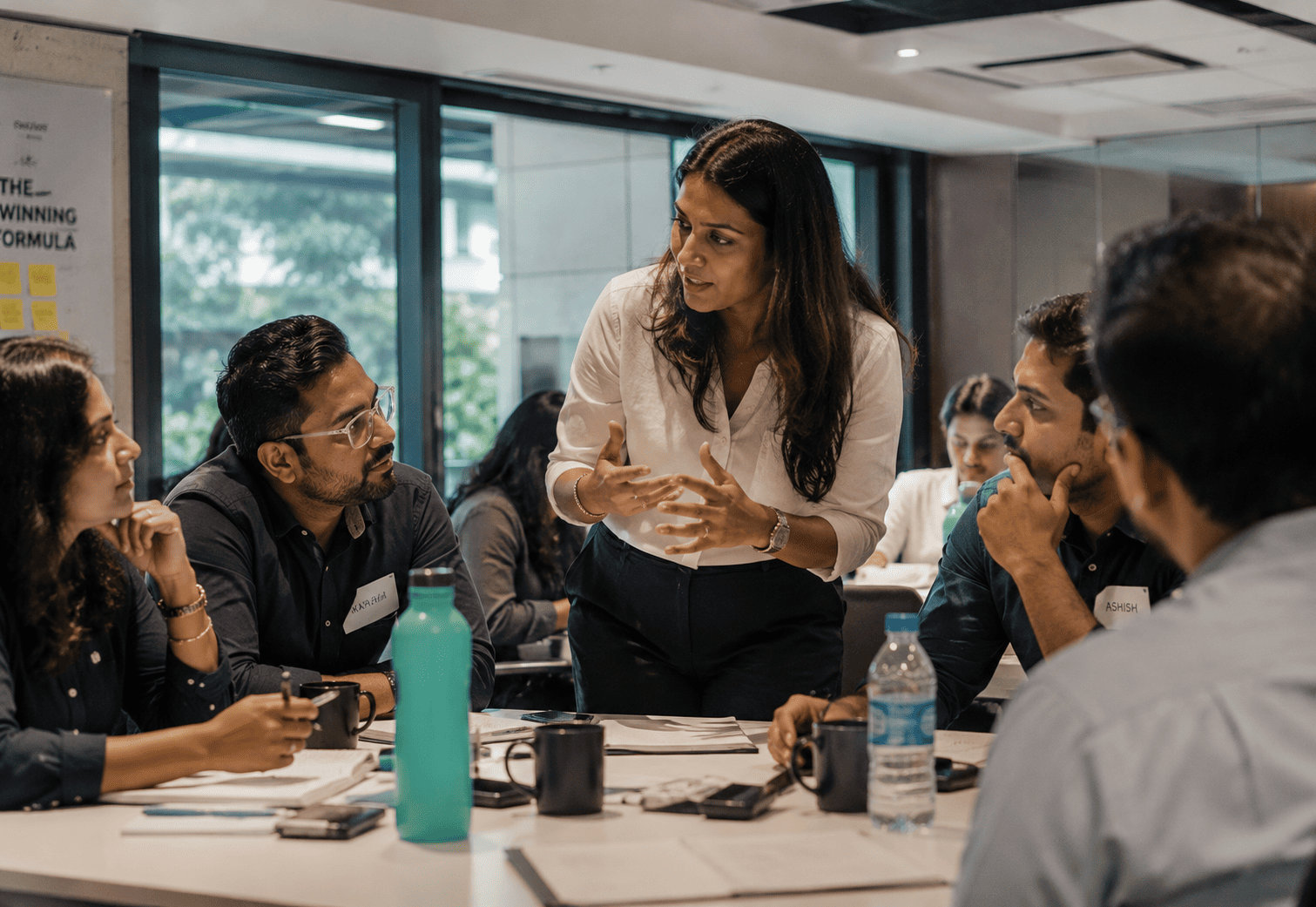
We don't lecture. We facilitate. That means we design experiences that your team actually goes through together — and then we process those experiences in ways that generate genuine insight and behaviour change.
There's a version of team facilitation where a trainer stands at the front of the room, runs through a set of activities, says something inspiring, and leaves. Everyone feels motivated for about a week. Then nothing changes. That's not what we do. Senior experts with more than 22+ years of experience in management, leadership, and organization development serve as our facilitators.
They have handled real performance challenges, led real teams, resolved real conflicts, and negotiated the type of complexity that isn't covered in textbooks. They bring that experience to your team meeting. That's the distinction between authentic facilitation and scripted facilitation. Your group will notice. When working with someone who has obviously been in the room they are describing, people open up differently.
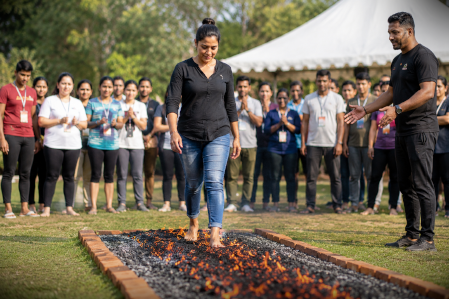
For programmes that include outdoor or adventure-based activities, our supporting facilitators are qualified outdoor instructors with proper training in safety and risk management. So the experience is challenging and impactful — and handled with full professionalism throughout.
Sustaining High Performance — The Follow-Up That Most Programmes Skip
Getting Roots believes that the real work begins after the programme ends.
We support teams through:
- Structured check-ins between sessions
- Leader coaching to help managers apply what the team has learned
- Metrics and reflection tools that track real progress — not just satisfaction scores
- Revisiting and recalibrating when teams go through transitions
This is how change becomes culture, not just a memory from an offsite.
Our Facilitators — People Who've Done the Work
Our facilitators are not trainers who read books about leadership. They're professionals who have managed teams, led organizations, navigated conflict, and dealt with the messy reality of getting people to work well together.
They bring that experience into the room — which means your team gets practical wisdom, not theory. And they are skilled at creating the kind of psychological safety where real conversations can happen.
At Getting Roots, facilitation is a craft we take seriously.
Team Development Models We Use
At Getting Roots, we don't pick one model and apply it to every team. We use a combination of proven frameworks, selected based on what's most relevant to your team's situation.
Tuckman's Model of Team Development: Forming, Storming, Norming, Performing, and Adjourning. This model helps us understand where your team currently sits in its development journey — and what kind of support is most useful at each stage.
Lencioni's Five Dysfunctions: Absence of Trust. Fear of Conflict. Lack of Commitment. Avoidance of Accountability. Inattention to Results. This framework gives teams a clear diagnostic lens — and a structured way to address what's actually holding them back.
Curphy and Hogan's Rocket Model: A research-based model built on eight components: context, mission, talent, norms, buy-in, power, morale, and results. Practical and specific.
The Drexler-Sibbet Team Performance Model: A seven-stage model covering both team creation and sustained high performance. We use it as a framework for building a shared language around how the team works and what it's working toward.
By combining capability-commitment thinking with stage-based development models, we design interventions that match where your team is — not where a generic programme assumes it is.
Sustaining High Performance: The Follow-Up That Matters
Most team training ends when the facilitator leaves. Motivation fades. Old habits return. Six months later, the team is back where it started.
We build our programmes with this in mind.
Getting Roots' team development engagements typically include two to five days of offsite facilitation, followed by three to six months of sustained development. This post-programme phase includes:
- A structured review session one month after the programme — to look at what's changed, what's sticking, and what needs reinforcement
- A detailed Teaming Manual and individual action plans, so every participant leaves with a clear picture of what they're committing to
- Weekly micro-learning follow-ups that keep momentum going without adding significant time pressure
- A Behavioural Observation Report shared with the organization, covering each participant's strengths, development areas, and specific recommendations
This is how learning becomes behaviour — and behaviour becomes culture.
Executive Team Development: When the Top Team Needs to Work Better Together
The performance of your executive team shapes everything below it.
When senior leaders are aligned, communicate clearly, and trust each other, those qualities ripple through the organization. When they're not, the dysfunction is equally contagious.
Getting Roots has worked with executive and leadership teams across major Indian cities — helping them move past surface-level collegiality into the kind of genuine alignment that drives organizational performance. Our executive team development work is confidential, highly customized, and grounded in real assessment rather than assumptions.
If your senior team has untapped potential, this is where to start.
High Performance Team Development Across India
We've delivered High Performance Team Development in India across a wide range of industries — from manufacturing and pharmaceuticals to banking, technology, and FMCG. Our clients include some of India's best-known organizations, and our work spans Delhi, Mumbai, Bangalore, Chennai, Hyderabad, Kolkata, Rajasthan, and beyond.
With 22+ years of experience and a 5.0 Google rating, we bring both the credibility and the practical expertise that this kind of work demands.
Whether you're based in a metro or managing a distributed team across regions, we design programs that work in your context.
Benefits of High Performance Team Development with Getting Roots
Here's what teams and organizations consistently report after working with us:
- Stronger trust — built deliberately, not assumed
- Clearer communication — less guessing, more directness
- Better collaboration — across roles, functions, and seniority levels
- Shared accountability — people owning outcomes, not passing the buck
- Reduced conflict — or rather, conflict that gets resolved instead of festering
- Strategic thinking — teams that can step back from tasks and see the bigger picture
- Improved team cohesion — people who actually want to work together
- Leadership capability across the team — not just at the top
- Adaptability — teams that handle change without losing their footing
- Results — the kind that show up in performance reviews, client satisfaction, and business outcomes
These aren't soft benefits. They're the things that determine whether your organization achieves its goals or falls short of them.
Ready to Build a Team That Actually Performs?
Talented people don't automatically make great teams. That gap — between having the right people and getting the right results — is exactly where Getting Roots works.
Whether you're dealing with a new team that needs a strong foundation, an established team that's lost its momentum, or a senior team that needs to work at a higher level — we have the process, the facilitators, and the experience to help.
We've worked with teams across Delhi, Mumbai, Bangalore, Chennai, Hyderabad, Kolkata, Rajasthan, and beyond. With 22+ years of experience and a 5.0 Google rating, we know what it takes to build teams that don't just perform on the day of the programme — but consistently deliver long after it's over.
Talk to us. Tell us what's happening with your team. We'll tell you what's possible.
Contact Getting Roots for High Performance Team Development →