
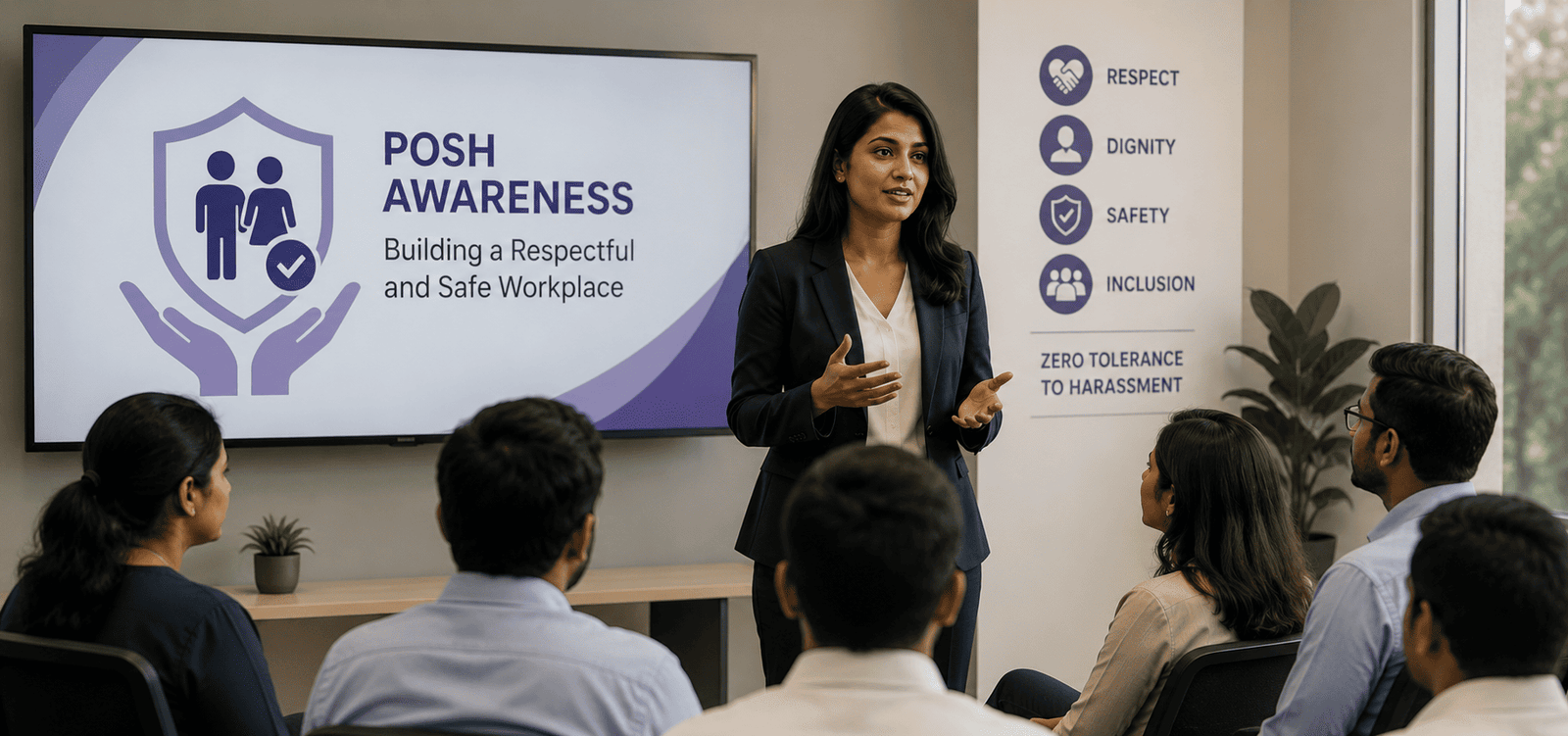
POSH stands for Prevention of Sexual Harassment. The Sexual Harassment of Women at Workplace (Prevention, Prohibition and Redressal) requires Indian employers to take active steps to prevent harassment, educate their workforce, and set up internal redressal mechanisms.
POSH awareness training is the educational component of this mandate. Its job is to ensure that every employee — from the shop floor to the boardroom — understands what sexual harassment is, what it is not, how to report it, and what happens after a complaint is filed.
Here's the problem: most HR teams don't say out loud
You've done the POSH act training. The policy is on the intranet. The Internal Committee exists on paper. But when an employee actually faces harassment, they don't know who to call, they're not sure the IC is impartial, and they're genuinely afraid of what happens if they speak up.
That gap — between documentation and reality — is where legal risk lives. And it's exactly what poor POSH training for employees creates.
Why POSH Awareness Training in India Is About More Than a Fine
Yes, the POSH Act makes training mandatory. Any organization must conduct awareness programmes, maintain an Internal Committee, and display the policy visibly. First-time non-compliance carries a fine of up to ₹50,000. Repeat offences can lead to business licence cancellation.
But here's what most compliance-focused training misses: the fine is the least of your problems.
When POSH compliance training is treated as paperwork, it sends a clear message to your team — this is something we do because we have to, not because we mean it. And the people who message lands hardest for? They're the ones it was designed to protect.
Organizations where employees feel unsafe don't just face legal risk. They lose good people quietly. They develop cultures where toxic behaviour gets normalized because nobody trusts the process enough to challenge it. That's not a compliance problem — it's a business problem.
| ₹50,000 | Minimum penalty for non-compliance under the POSH Act |
| 10+ | Employees = mandatory Internal Committee & POSH training |
| 1 yr | Recommended frequency for refresher POSH compliance training |
Who Needs POSH Training for Employees — and What the Law Actually Says
The POSH Act applies to all workplaces in India — corporate offices, factories, hospitals, educational institutions, NGOs, and even remote or work-from-home arrangements. If an organization employs 10 or more people, it must constitute an Internal Committee (IC) and ensure regular awareness training.
But the law's scope is broader than many HR teams realise. It covers:
- Permanent, temporary, part-time, and contract employees
- Interns, trainees, and apprentices
- Third-party vendors and clients visiting the premises
- Remote employees interacting through digital channels
Failing to conduct regular POSH act training can result in fines, cancellation of business licences in the case of repeat offences, and — perhaps more damagingly — public reputational harm when incidents come to light without a clear response framework in place.
Compliance aside, there is a business case that rarely gets talked about. Organizations where employees feel physically and psychologically safe show measurably lower attrition and higher engagement scores. POSH training for employees is not a cost centre — it's an investment in the quality of your workplace culture.
The 5 Pillars of a Genuinely Effective POSH Compliance Training Programme
Not all POSH training is created equal. Here's what separates programmes that change behaviour from ones that just tick boxes.
1. Legal Literacy Without the Legalese
Employees need to understand the POSH Act — its definitions, its timelines, its protections — but not through 40 minutes of dense statutory text. Good POSH awareness training translates legal language into plain speech. What counts as verbal harassment? Does a WhatsApp message qualify? What about a comment made at an office party? These are the questions people actually have, and a strong programme answers them directly.
2. Role-Specific Content for Managers and IC Members
Frontline employees, managers, and Internal Committee members need different things from POSH training in India. A general session that treats all three the same tends to be too basic for some and not hands-on enough for others.
Managers need guidance on how to receive a complaint, how to document early warning signs, and how not to accidentally retaliate or discourage the person from filing formally. IC members need training on investigation procedures, evidence handling, natural justice principles, and preparing inquiry reports. These are specialized skills — and they should be developed through specialized sessions, not generic awareness content.
3. Language and Format Accessibility
India has over 22 official languages and hundreds of dialects. A POSH training programme that runs exclusively in English and assumes high literacy is not a programme — it's a formality. Genuinely effective POSH training for employees includes vernacular language options, visual formats, and in some cases, facilitator-led group discussions for workers who may not engage well with text-heavy modules.
4. Scenario-Based Learning
Scenario-based learning outperforms lecture-style content in almost every adult learning study. When employees work through realistic situations — a junior employee made uncomfortable by a senior's comments during a video call; a colleague unsure whether to report something witnessed, not experienced — they build the judgment to act, not just the knowledge to recognize.
This is the core reason why corporate training programmes that invest in experiential methods produce better outcomes than those that don't.
5. Continuity — Not Annual Amnesia
One training a year and nothing in between is a recipe for erosion. Effective POSH compliance training works in layers: a thorough onboarding module when someone joins, a policy refresher annually, and shorter awareness nudges throughout the year — a case study, a policy reminder, a facilitated discussion during a team meeting. The goal is to keep the norms alive, not just audit-ready.
Online POSH Training vs. Onsite: What Actually Works for Modern Indian Workforces
The debate between online POSH training and in-person sessions has largely been resolved by the reality of how Indian organisations now operate. Most companies need both — just not in equal measure or for the same purposes.
| Format | Best For | Limitations |
| Online POSH Training | Geographically distributed teams, large headcount rollouts, documentation & tracking at scale, self-paced learning | Lower engagement if poorly designed; harder to address sensitive follow-up questions |
| Onsite / Facilitator-Led | IC member training, manager sensitization, Q&A-heavy sessions, organizations dealing with active culture concerns | Logistically demanding; cost per head higher for dispersed teams |
| Hybrid (Recommended) | Most mid-to-large organizations; combines foundational e-learning with live debrief or coaching | Requires planning and coordination between L&D and HR |
Getting Roots offers both online POSH training and onsite facilitation — and helps organizations decide which blend makes sense given their size, culture, and compliance gaps. Our soft skills training programmes in India are built on the same philosophy: format should serve the learner, not the trainer's convenience.
Important note on certificates: Completion certificates from a POSH training session are not a substitute for genuine IC functioning or a well-drafted policy. They are one piece of evidence in a broader compliance picture. If your IC has never been trained on inquiry procedures, a certificate from a one-hour module won't protect the organisation.
Who This Training Is Built For — and Why Each Group Needs Something Different
One of the biggest mistakes in POSH training for employees is treating everyone the same. A frontline worker in a factory needs different content — and a different format — than a senior manager in a corporate office.
For All Employees
The foundation: what counts as sexual harassment under the POSH Act, how to report it, what confidentiality means, and what happens after a complaint is filed. This is where most programmes stop. We treat it as the starting point.
For Managers and Team Leads
Your managers are often the first person an employee approaches — or avoids. They need to know how to receive a disclosure without dismissing it, how to document what they're told, when to escalate formally, and how to behave toward both parties during an ongoing inquiry. Get this wrong and the whole system breaks.
For Internal Committee Members
IC training is a separate, specialised programme. It covers the inquiry process step by step, natural justice principles, how to handle evidence, timelines under the Act, and how to write a final report. This is not a job you can do from reading the policy PDF once. Our POSH Act training for IC members runs as a dedicated half-day or full-day session.
What Blue-Collar and Frontline Workforces Need — and Don't Usually Get
This is the blind spot that most POSH training vendors won't tell you about. The POSH Act doesn't apply only to white-collar office environments. Manufacturing units, logistics operations, retail chains, and hospitality businesses all fall under the same mandate — but their workforces often have very different relationships with formal training.
For frontline and blue-collar employees, POSH awareness training needs to account for:
- Language barriers — English-only or Hindi-only modules will not reach Tamil Nadu, Odisha, or Assam effectively
- Literacy levels — Audio-visual and facilitated group formats work better than written modules
- Power dynamics — In hierarchical environments, employees may fear that raising a complaint will cost them their job. Training must address this directly, not assume the IC will handle it
- Incident normalisation — In some work cultures, certain harassing behaviours have been normalised for so long that employees don't recognise them as violations. Scenario-based content is especially important here
At Getting Roots, our approach to outbound and experiential training in India is built on the understanding that the medium of learning matters as much as the content. This same principle applies to POSH awareness work.
How We Set Up Your POSH Compliance Training — From First Call to Certificate
1 Discovery & Needs Assessment
We start by understanding your organisation: workforce size and composition, existing POSH policy status, IC setup, languages spoken, and any incidents or patterns HR has flagged. This shapes everything that follows.
2 Custom Programme Design
We build a content plan that fits your context — industry-specific scenarios, role-appropriate tracks, appropriate language and format for your workforce mix. Not a template. An actual programme.
3 Delivery — Online, Onsite, or Hybrid
Sessions run according to your schedule. Employee awareness, manager training, and IC member training can be batched or phased across weeks. We handle the logistics; you focus on getting people there.
4 Assessment & Certification
Every participant completes a post-session assessment. Completion certificates are issued digitally with audit-ready records for HR documentation.
5 Follow-Through & Refreshers
One session a year isn't enough to sustain culture. We offer quarterly awareness nudges, annual refresher modules, and optional IC readiness audits to keep your compliance genuinely current.
Building Safer Workplaces Is Part of a Bigger Picture
POSH training doesn't work in isolation. The most compliant organisations are also the ones where leadership sets the tone, managers handle difficult conversations well, and teams communicate with genuine respect. That's why so many organizations partner with Getting Roots across multiple areas of people development.
If you're working on POSH compliance, you might also find value in our leadership development programmes for building leaders who model respectful behaviour, our managerial skills training for equipping people managers to handle sensitive situations confidently, and our team development programmes for creating the kind of team culture where harassment is less likely to take root in the first place.
Our executive coaching and business consulting work also frequently surfaces culture and safety issues that POSH training alone can't fix — and we help organisations address those at the root.
For more on how training drives real business performance, see our guides on building high-performance teams through corporate training and soft skills training in India.
What a Getting Roots POSH Training Engagement Includes
We don't drop a standard deck and leave. Here's what you get when you work with us:
- Pre-training needs assessment — we find out where your gaps actually are before designing anything
- Customised content for your industry, workforce type, and organisational culture
- Separate tracks for employees, managers, and IC members
- Available as online POSH training (self-paced e-modules), live facilitated sessions, or a hybrid of both
- Delivery in English, Hindi, and regional Indian languages on request
- Completion certificates for every participant
- Post-training IC readiness audit available as an add-on
- Refresher modules and annual recall sessions to prevent knowledge erosion
The Hidden Cost of Getting POSH Training Wrong
Let's be direct about what's at stake when organisations treat POSH training as a paperwork exercise.
The most visible risk is legal: fines, tribunal orders, and potential business licence suspension. These are real, and they get organisations moving. But the less visible costs are often more expensive in the long run.
When employees know that the training was perfunctory — that management sat through a session out of obligation, that the IC exists on paper but has never been properly trained — it sends a message. The message is that the organisation doesn't actually care. And that message gets read loudest by the people it was meant to protect.
The result: complaints go unreported. Toxic behaviours persist. Your best talent, who have other options, leaves quietly. And when an incident finally surfaces, there's no credible internal framework to respond with — which makes both the legal and reputational fallout significantly worse.
Contrast that with what happens when POSH awareness training is done seriously. Employees know what the policy says. They know who the IC members are and trust them. They've been through realistic scenarios and have some sense of how to act. That is an organisation that can manage a complaint professionally, resolve it fairly, and emerge with its culture intact.
Our leadership development programmes and managerial training in India consistently reinforce one insight: the tone on POSH compliance is set at the top. When leaders take it seriously — when they participate in the same training, speak openly about why it matters — employees follow.
How Getting Roots Designs POSH Training in India That Actually Works
Getting Roots is a corporate training company in India with a focus on building capability that translates into real behaviour change — not just compliance documentation. Our POSH awareness training programmes are designed around three core commitments.
Context Before Content
Before we build a programme, we assess where the organisation actually is: Is this a first-time rollout or a cultural reset? Has there been a recent incident? What is the IC's existing capacity? The answers change what we build. A manufacturing company in Maharashtra with 300 frontline workers needs a fundamentally different programme than a 40-person startup in Bengaluru.
Facilitators Who Understand Indian Workplaces
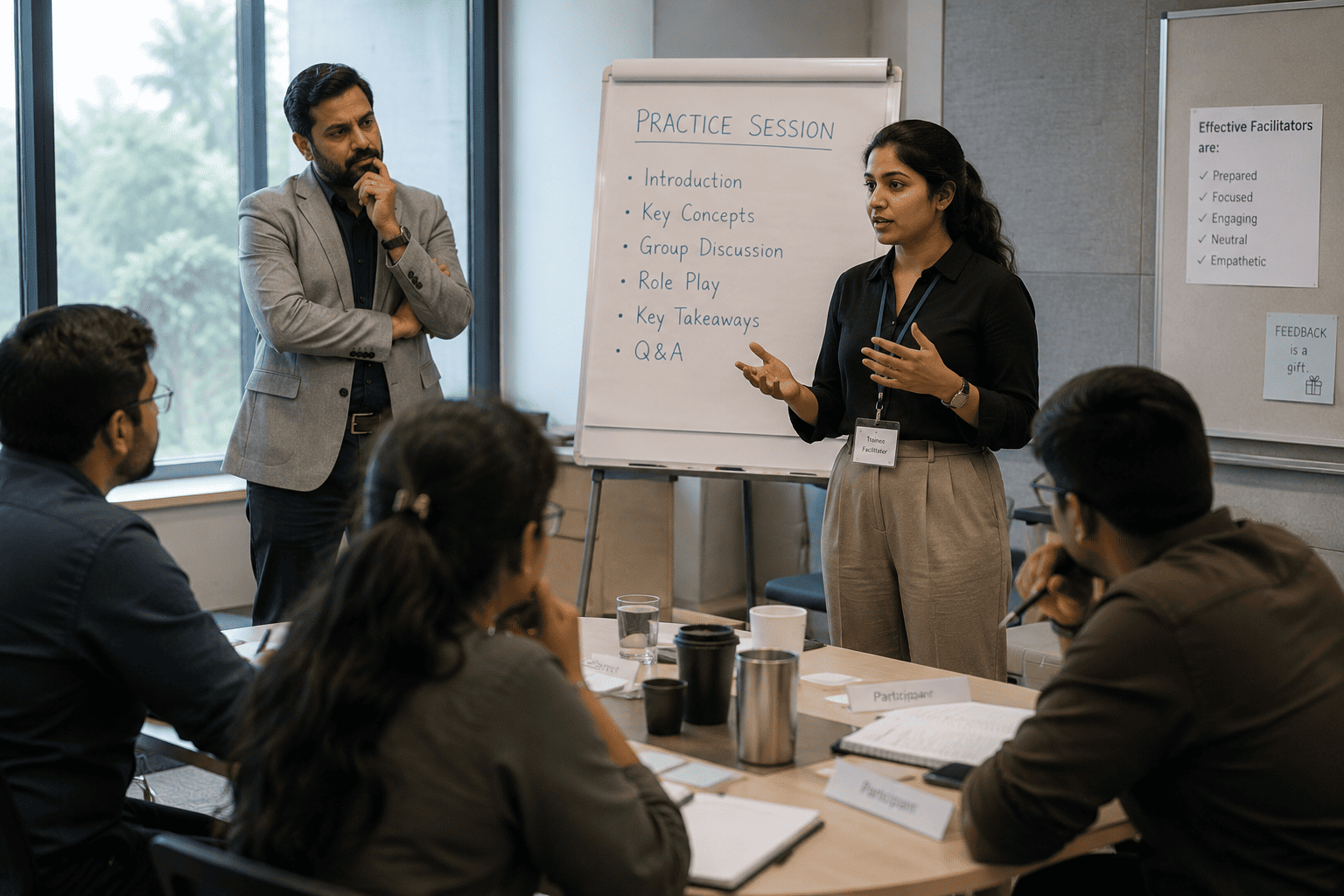
POSH content doesn't land the same when it's delivered by someone who has no frame of reference for how Indian offices, factories, or hierarchies actually work. Our facilitators bring that context. They are familiar with the power structures, the regional variations, and the cultural hesitations that employees carry into these conversations. This matters enormously for trust.
Measurable Outcomes, Not Just Completion Rates
We track more than certificates. Post-training assessments, IC readiness audits, and follow-up facilitated reviews tell us whether the training has actually shifted understanding — and where gaps remain. This is consistent with how we approach all our train-the-trainer programmes in India and corporate IT training: outcomes first, delivery second.
Our broader work on high-performance team development and executive coaching in India is built on the same foundation — and it reflects in the quality of our POSH compliance training.
Ready to Build a Safer, Legally Compliant Workplace?
Getting Roots designs POSH awareness training in India that goes beyond compliance — training that employees actually remember and managers actually use. Whether you need a one-off employee session, full IC member training, or an annual compliance programme, we'll build it around your organization's real needs.