

Types of Corporate Training Programs in India: A Practical Guide to Every Type and When to Use It
Most organizations do not have a training problem. They have a wrong-training problem.
They invest in a leadership workshop when the real issue is cross-functional communication. They roll out a technical upskilling sprint when what their managers actually need is accountability training. Six months later, when performance numbers have not moved, a quiet question surfaces in every L&D meeting: Did that even work?
The answer is rarely that training does not work. It is almost always the wrong type of training was chosen for the actual gap.
India's corporate training market is projected to grow at 12–15% annually through 2026, driven by digital transformation, rising leadership demands, and the pressure on L&D teams to show measurable ROI — not just satisfied participants. Yet the organisations that see real results are not necessarily spending more. They are choosing better.
This guide breaks down every major type of corporate training program in India, what each one is genuinely built to fix, and how to determine which your organization needs right now — not based on what is trending, but based on what your specific performance gaps actually require.
What Are the Main Types of Corporate Training Programs?
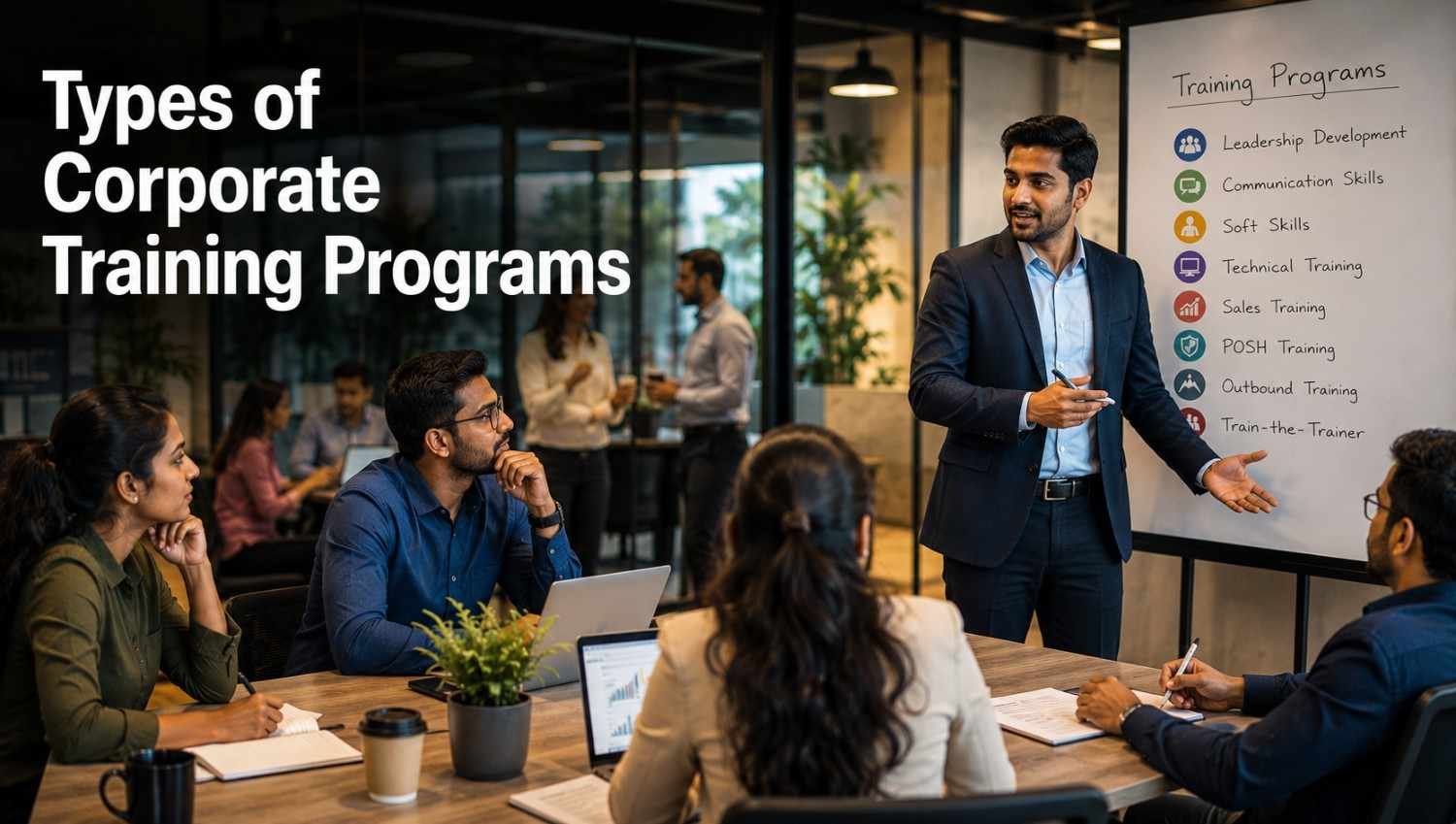
The main types of corporate training programs include soft skills training, leadership development, technical training, communication skills training, sales training, outbound and experiential training, train-the-trainer programs, and POSH training. Each addresses a distinct category of workforce performance gap. Choosing the wrong type produces activity without impact — a common and expensive mistake for L&D teams across India.
That is the short answer. What follows is the decision framework.
1. Soft Skills Training — When the Gap Is How People Show Up at Work
Soft skills training addresses the behaviors that determine how effectively a person performs in a team, a client conversation, a high-pressure moment, or a difficult workplace relationship. It covers emotional intelligence, adaptability, professional presence, conflict resolution, time management, and the interpersonal habits that either amplify or undermine technical competence.
This is consistently the most-requested category of corporate training programs in India — and with good reason. Technical skills get someone hired. Soft skills determine how far they go and how much value the people around them produce as a result.
When your organization needs it: When teams are technically capable but interpersonal friction is slowing decisions, damaging client relationships, or generating management problems that a policy update cannot solve.
What Getting Roots does differently: Soft skills programs at Getting Roots are designed around specific behavioral outcomes, not topic checklists. A program on emotional intelligence is built around what participants should do differently in real workplace situations — not around how accurately they can define the concept.
→ Explore Soft Skills Training at Getting Roots
2. Leadership Development — When the Gap Is at the Management Layer
Leadership development is one of the most commonly requested types of corporate training programs in India — and one of the most frequently misapplied. Most organizations need it not because their leaders are failing, but because leadership behaviors were never formally built. High performers were promoted because they delivered results individually, then expected to lead teams without being taught how.
Effective leadership training covers decision-making when information is incomplete, holding people accountable without creating resentment, managing performance conversations that actually change behaviour, and building the kind of credibility a team follows because of trust — not just title.
When your organization needs it: When managers are technically competent but struggling with people management. When high-potential employees are being developed for larger roles. When the organization is scaling, and leadership bench strength has not kept pace with headcount growth.
A note on depth: Leadership is a learned set of behaviors, not a personality type. A two-day workshop introduces frameworks. Durable leadership capability is built through structured practice over time, with feedback loops and real application between sessions.
→ Explore the Leadership Skills Journey at Getting Roots
3. Technical Training — When the Gap Is Role-Specific Capability
Technical training addresses domain-specific skill gaps: the tools, systems, processes, and knowledge a person needs to perform their specific role at the level the organization actually requires.
This type is often underestimated in business impact. Role-specific capability gaps are one of the quietest drags on productivity because they rarely surface cleanly — a team member who does not fully understand a core system or is applying an outdated method looks busy while producing work that is slower and less accurate than it should be.
When your organization needs it: When new tools or systems are being adopted. When role requirements have shifted and current capability has not kept pace. When onboarding new employees who need to reach full competency quickly. When performance data consistently points to errors in specific technical areas.
Technical training programs at Getting Roots are built around your team's actual tools, workflows, and job requirements — not generic modules that need extensive contextualization before anyone can apply them on Monday morning.
→ Explore Technical Training at Getting Roots
4. Communication Skills Training — When the Problem Is How Information Moves
Communication skills training is distinct from soft skills training in scope. Where soft skills training covers a broad range of interpersonal behaviors, communication skills training focuses specifically on how people convey information: in writing, in meetings, in presentations, in feedback conversations, and in high-stakes discussions where the wrong phrasing can stall a decision or damage a working relationship.
The cost of poor communication inside organizations is consistently underestimated. Missed expectations, stalled projects, and avoidable conflict often trace back not to bad intentions but to conversations that went poorly — or never happened at all.
When your organization needs it: When cross-functional projects repeatedly generate friction. When client communication creates complaints. When written communication — emails, reports, proposals — does not meet professional standards. When feedback culture is weak, managers routinely avoid difficult conversations rather than have them.
5. Sales Training — When the Gap Is Between Conversations and Closed Business
Sales training addresses the full range of behaviors that convert a prospect into a client — from how to open a conversation, to how to handle the objections that end most deals before they reach a decision point. Effective sales training is not about scripts. It is about building situational judgment to read a conversation and the skill to move it toward a conclusion.
The most common mistake organizations make with sales training is treating it as a one-time event. A two-day program can introduce frameworks. Sustained improvement in conversion rates comes from practice, feedback, and structured reinforcement over time — not from a single workshop.
When your organization needs it: When conversion rates are below expectations. When the team builds strong pipelines but loses deals at the closing stage. When new salespeople take too long to reach productive output. When customer interactions are technically professional but commercially ineffective.
Organizations that have completed Getting Roots sales training programs report an average 30% improvement in conversion rates — measured through behavioral tracking after the program, not through session satisfaction scores.
6. Outbound and Experiential Training — When the Issue Is Interpersonal Dynamics, the Classroom Cannot Reach
Outbound training uses outdoor, activity-based learning to address team challenges that structured classroom sessions rarely resolve. Low trust between colleagues, poor collaboration under pressure, reluctance to take shared accountability, and cross-functional tension are behavioral patterns that a seminar room does not reliably fix — because the training environment is too different from the conditions under which those behaviors actually occur.
Outbound training places teams in situations where the same interpersonal dynamics that cause problems at work will surface naturally. That creates the opportunity to address them directly, build shared reference points, and begin rebuilding trust in a context where defensiveness is lower.
Industry data supports this: employees retain up to 75% of information through experiential learning, compared to roughly 10% through passive methods. For team dynamics work, the difference in transfer back to the job is even more pronounced.
When your organization needs it: When team-building workshops have produced good feedback scores but no visible change in how the team actually operates. When cross-functional tension is creating project delays or escalations. When a newly formed or recently reorganized team needs to build trust quickly. When trust has broken down following a significant organizational change.
→ Explore Outbound Training at Getting Roots
7. Train the Trainer Programs — When You Need Internal Training Capability
Train the Trainer programs are designed for professionals who will deliver training internally — whether that means onboarding new employees, running departmental skill-building sessions, or maintaining consistent learning standards across a distributed organisation.
The gap between a confident subject-matter expert and an effective facilitator is significant. Facilitation requires managing a room, handling resistance and unexpected dynamics, adapting content when the group is not where you expected them to be, and measuring whether learning actually transferred — not just whether participants said they enjoyed the session.
When your organization needs it: When there is heavy and ongoing reliance on external providers for content that internal facilitators could deliver consistently. When internal training quality varies across departments. When an organization is scaling and needs to build a sustainable, internal learning infrastructure, rather than commissioning external programs for every recurring training need.
Getting Roots' Train the Trainer program is built around live delivery practice, not written assessments. Participants leave with the practical skills to lead sessions confidently — including managing resistance, adapting on the fly, and evaluating whether learning transferred back to the job.
→ Explore Train the Trainer at Getting Roots
8. POSH Training — When Compliance Is a Legal Requirement, Not a Choice
POSH (Prevention of Sexual Harassment) training is a statutory requirement for every organization in India with ten or more employees, under the Sexual Harassment of Women at Workplace (Prevention, Prohibition and Redressal) Act, 2013. Every such organization must conduct regular awareness programs and provide specific training to members of the Internal Complaints Committee (ICC).
Beyond the legal dimension, POSH training contributes to building a workplace where employees feel safe, respected, and clear on both their rights and their responsibilities. Organizations that treat it as a compliance checkbox typically deliver training that leaves participants no clearer than before. Organizations that treat it as a cultural investment see measurable differences in how their teams report, respond to, and prevent incidents.
When your organization needs it: As a baseline requirement for all organizations above the statutory threshold — and as a regular, structured refresh rather than a single annual event.
→ Explore POSH Training at Getting Roots
How to Choose the Right Type of Corporate Training Program
Given eight distinct types — and the reality that most organizations carry more than one performance gap simultaneously — the decision framework is as important as the menu of options.
Start with the performance gap, not the program category. The question is not "what kind of training should we run?" It is "what is actually not working, and what behaviour change would fix it?" That question, answered precisely, points to the right intervention.
Distinguish between knowledge gaps, skill gaps, and behavioral gaps. A knowledge gap means people do not know something. A skill gap means they know it but cannot do it reliably under real conditions. A behavioral gap means they can do it, but do not — because the environment, habits, or incentives work against it. Each requires a different type of intervention, and getting this wrong is how organizations end up running the right program for the wrong problem.
Match format to the depth of change required. Even within the correct type, a two-day capsule program and a twelve-week behavioral journey produce fundamentally different results. The capsule works when you need rapid upskilling on a specific, well-defined gap. The journey works when you need durable change across a broader capability area — the kind of change that still shows up six months later.
Resist the pull of popular programs. Leadership development is not the right answer when the actual issue is that managers do not have the communication skills to give useful feedback. Outbound training is not the right answer when the actual issue is a structural conflict between departments that requires a managerial decision, not a team activity.
At Getting Roots, every engagement begins with a learning needs assessment — not as a procedural step, but because this is what separates programs that change behaviour from programs that produce good feedback scores and then quietly disappear from day-to-day work.
Why Getting Roots for Corporate Training Programs in India
Getting Roots has delivered corporate training programs across IT, manufacturing, BFSI, healthcare, startups, educational institutions, and enterprises throughout India for over 22 years. The consistent thread across every engagement: training is only worth the investment when it transfers back to the job.
Every program is built around your organization's specific gaps, business objectives, and the behaviural outcomes that will actually show up in performance — not adapted from a generic module designed for a different company in a different sector.
Programs are available in two formats:
Capsule programs — for rapid upskilling on specific, time-sensitive gaps. Short duration, low operational disruption, fast ROI.
Deep impact learning journeys — for sustainable behavioral change across broader capability areas. Structured over weeks or months, with built-in practice, feedback loops, and follow-through between sessions.
Both formats are built on the same principle: participants do not just understand new concepts. They practice them under conditions close enough to real work that the skills transfer when they return to their desks.
Proven outcomes from Getting Roots programs:
- 40% increase in team productivity (measured post-program)
- 30% improvement in sales conversion rates (tracked through behavioral assessment)
- 2× growth in employee engagement scores
If you are trying to identify which type of training your organization needs, a structured learning needs assessment is the most reliable starting point. It clarifies what the actual gap is, which type of intervention fits, and what outcomes are realistic within your timeline and budget.
→ Request a free consultation with Getting Roots
Frequently Asked Questions
What are the main types of corporate training programs in India?
The main types of corporate training programs in India are soft skills training, leadership development, technical training, communication skills training, sales training, outbound and experiential training, train-the-trainer programs, and POSH training. Each addresses a distinct category of organizational performance gap. The right type depends on your specific situation — not on what is most commonly purchased in your sector.
How do I know which corporate training program my organization needs?
Start with the performance gap, not the program category. Identify what is not working at the business level, then trace it back to the skill or behaviour that training could address. A learning needs assessment — conducted before any program design — is the most reliable way to make this determination accurately. Choosing without this step is how organizations end up running the right program for the wrong problem.
What is the difference between soft skills training and communication skills training?
Soft skills training addresses a broad range of interpersonal behaviors — emotional intelligence, adaptability, workplace relationships, and professional presence. Communication skills training focuses specifically on how information is conveyed: in writing, meetings, presentations, feedback conversations, and high-stakes discussions. Communication training is often a component of broader soft skills programs, but can also be delivered as a focused, standalone intervention when that is where the specific gap sits.
How long do corporate training programs in India usually last?
Program duration ranges from focused one-day workshops to multi-month structured learning journeys, depending on the type and depth of change required. Capsule programs typically run one to three days and address a specific, well-defined gap. Deep impact journeys span several weeks or months and are designed for durable behavioral change — not a short-term knowledge lift that fades within a quarter.
Is POSH training mandatory for organizations in India?
Yes. Under the Sexual Harassment of Women at Workplace (Prevention, Prohibition and Redressal) Act, 2013, all organizations in India with ten or more employees are legally required to conduct POSH awareness programs and provide training to the Internal Complaints Committee (ICC). Non-compliance carries legal penalties and significant reputational risk.
Getting Roots is a corporate training and organizational development company based in Delhi, with 22+ years of L&D experience across India. Programs cover soft skills, leadership, technical training, outbound learning, sales, communication, train the trainer, and POSH — each built around your organization's specific performance gaps.
→ Explore Getting Roots Corporate Training Programs
About Getting Roots Getting Roots is one of India's experienced corporate training and L&D companies, operating for over 22 years across Delhi NCR, Mumbai, Bangalore, and pan-India. With a focus on customized, outcome-driven learning, Getting Roots designs programs that produce measurable behavioral change — not just satisfied participants. View all Getting Roots services →
Follow us here:
• Join us on Facebook
• Follow us on Instagram
• Watch on YouTube