

Life Coaching in Delhi: What It Is, How It Works, and Whether You Need It
Most people who eventually hire a life coach don't do it because things are terrible. They do it because things are fine — and fine feels like a problem. The career is moving, but not in a direction that makes sense. Relationships work on the surface. There's enough money but not enough meaning. If any of that sounds close to home, you're probably not looking for therapy. Life coaching in Delhi is designed to provide the clarity and focus needed to move forward with confidence.
This guide covers what a life coach actually does (not the motivational poster version), how coaching works in practice, what it costs in India, and how to decide whether it's the right move for you. Getting Roots has worked with professionals across Delhi NCR for over two decades — what you'll read here is grounded in that experience, not borrowed from a textbook. At that point, I knew I felt stuck, but I didn't fully understand what a life coach actually does. If you're exploring coaching for the first time, read Life Coaching in Delhi: What It Is, How It Works, and Whether You Need It for a complete overview.
What a Life Coach Actually Does — Beyond the Buzzwords
The term "life coach" has picked up a lot of noise over the years. Social media has attached it to everything from fitness influencers to motivational speakers. That noise makes it harder to see what professional life coaching actually involves.
A life coach is a trained professional who works with you to identify where you're stuck, clarify what you want, and build a practical path forward. The work is structured, forward-focused, and goal-driven. It is not therapy, mentoring, or consulting — a coach does not give you answers. They ask the questions that help you find your own.
In a typical coaching engagement, you might work on a specific career decision, a leadership challenge, a pattern of procrastination you can't seem to break, or a feeling that you've outgrown your current life but don't know what comes next. The coach doesn't tell you what to do. They hold up a clear mirror, ask uncomfortable questions, and hold you accountable to the commitments you make to yourself.
What Happens in a Coaching Session
A standard life coaching session runs 45 to 60 minutes. It usually starts with a check-in: what happened since the last session, what changed, what didn't. From there, the focus narrows to one or two things that matter most right now. The coach asks questions. You think out loud. By the end, you walk away with a clearer perspective and at least one concrete action to take before the next session.
Sessions may take place in person, via video call, or over the phone. Many professionals in Delhi-NCR prefer video sessions because they fit in between meetings without the commute. The format matters less than the consistency — coaching only works if you show up regularly and do the work between sessions.
Life Coach vs Therapist: The Distinction That Matters in India
This is the question that trips people up most often, and it's especially relevant in India, where the mental health conversation is still evolving. The short answer is that therapists and life coaches serve different purposes — and choosing the wrong one wastes time and money.
If you'd like a deeper breakdown of where coaching ends and therapy begins, read The Difference Between a Life Coach and a Therapist — And Why It Matters More in India.
A therapist is a licensed mental health professional. They diagnose and treat psychological conditions — depression, anxiety, trauma, OCD, and similar issues. A life coach is not a mental health professional. They work with people who are functionally well but want to grow, perform better, or navigate a significant change.
Think of it this way: if you're struggling to get out of bed and experiencing persistent sadness that affects daily functioning, a therapist is the right call. If you're getting out of bed, going to work, managing life reasonably well, but feeling stuck, unfulfilled, or like you're playing it too safe — a life coach is more useful.
One more important distinction: therapists in India are regulated under the clinical psychology and psychiatry boards. A government body does not regulate life coaches. That's why credentials, experience, and word-of-mouth matter more when choosing a coach — there's no licensing body to fall back on.
The 7 Areas Life Coaching Works On
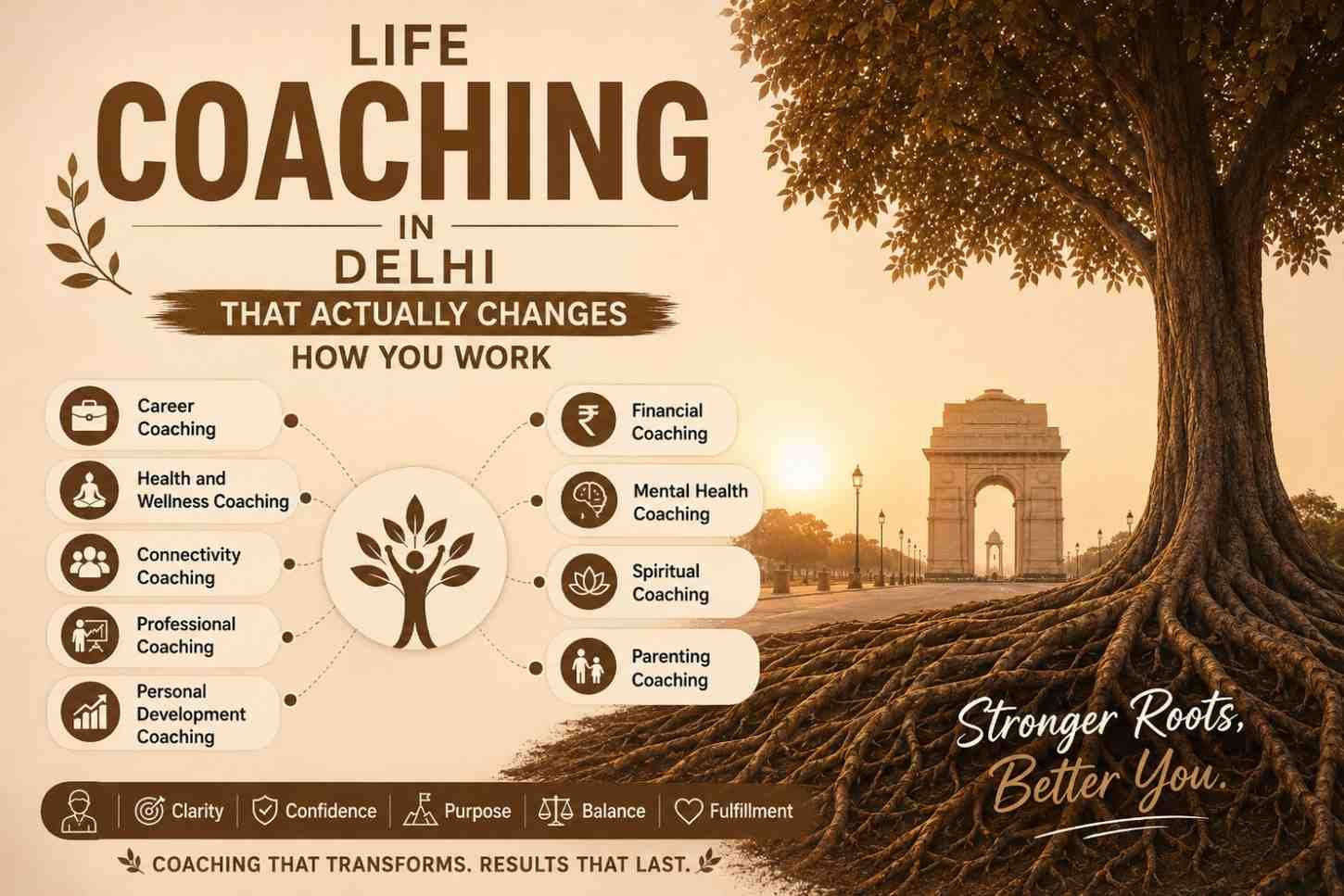
Life coaching isn't a single lane. Most coaches develop depth in two or three areas, though almost all of them eventually touch on the interconnected nature of these domains. Here are the seven core areas that come up most consistently in coaching work:
1. Career and professional growth — Direction, transitions, visibility, and figuring out whether the role you're in actually fits you.
2. Relationships and communication — Not just personal relationships, but how you show up in conversations at work, how you handle conflict, and whether you say what you actually mean.
3. Health and well-being — Energy, sleep, exercise habits, and the behaviours that either sustain or undermine performance.
4. Financial clarity — Not financial planning, but the beliefs and decisions around money that affect how people earn, spend, and think about security.
5. Personal development and self-awareness — Understanding your patterns, triggers, strengths, and the stories you tell yourself.
6. Leadership and confidence — How you lead teams, how you handle pressure, and whether you carry yourself in a way that reflects where you want to go.
7. Purpose and life direction — The harder, quieter questions about what you actually want and whether the life you're building matches the person you're becoming.
The 7 Stages of a Coaching Engagement — What to Expect
Most people walk into coaching not knowing what the process looks like. This uncertainty is part of why people delay starting. A structured coaching engagement moves through seven recognisable stages:
Stage 1 — Assessment: Where are you now? What's working, what isn't, and what's been the pattern? The coach gathers context without judgement.
Stage 2 — Goal Clarification: What does success look like, specifically? Not "I want to be happier" but "I want to have a clear direction for my next career move within the next three months." Vague goals often lead to unclear outcomes.
Stage 3 — Gap Analysis: What's standing between you and the goal? This is often the most revealing stage — the gap is rarely what people expect it to be.
Stage 4 — Action Planning: Building a realistic roadmap. Not a list of aspirations — a sequence of concrete steps with timelines and accountability.
Stage 5 — Skill and Mindset Development: Practising the new behaviours, responses, or thinking patterns. This is where most of the actual work happens.
Stage 6 — Accountability and Course Correction: Regular check-ins, tracking what's working, and adjusting what isn't. A good coach notices when you're drifting and brings you back without making it a lecture.
Stage 7 — Review and Transition: Consolidating what you've built. The goal isn't to stay in coaching indefinitely — it's to reach a point where you don't need it anymore.
7 Benefits of Life Coaching That Research Actually Supports
People report all sorts of improvements after coaching, and not all of them are easy to measure. But there's enough research to say this isn't just self-report bias. Here's what the evidence and practitioner experience consistently show:
1. Better self-awareness: Research has shown that fewer than 15% of people are genuinely self-aware despite believing they are. Coaching — because it involves consistent external feedback — closes that gap faster than most other methods.
2. Improved confidence: A study by the International Coaching Federation found that 80% of people who worked with a coach reported improved self-confidence. That's not a trivial number.
3. Clearer goals: One consistent finding across coaching outcome studies is that people who coach are more likely to achieve their goals than those who set goals without support. Accountability is the mechanism.
4. Better communication: Over 70% of people in one study reported improved work performance and communication skills after coaching. For professionals in Delhi's corporate environment, this is often the most immediately visible change.
5. Lower stress: Not because the external pressure disappears — but because your relationship with it changes. Coaching builds the internal capacity to handle pressure differently.
6. Stronger relationships: When you understand your own patterns better, you stop reacting and start responding. That shift changes relationships at work and at home.
7. Sustained change: Unlike workshops or seminars where the energy fades within days, coaching produces changes that stick — because the insights come from you, not at you.
Who Actually Benefits from Life Coaching in Delhi
Life coaching isn't for everyone. It works best for people who are already functioning — going to work, maintaining relationships, handling life's basics — but who want to function better or differently. Here's who typically gets the most from it:
Mid-career professionals (30–50) who've achieved external markers of success but feel internally adrift are the most common coaching clients in Delhi's corporate world. The job is good, the title is respectable, but there's a persistent feeling of running on a treadmill rather than going somewhere.
Senior managers and leaders who are technically strong but are now managing people, navigating politics, and needing skills that no MBA covered — presence, emotional regulation, influence without authority.
Entrepreneurs who are building something and find themselves overwhelmed not by the business problem but by their own reactions to it — perfectionism, fear of visibility, inability to delegate.
Professionals at a career crossroads — considering a pivot, a promotion, a relocation, or a completely new direction — who want structured thinking space rather than just more advice from friends or family.
People going through significant personal transitions — divorce, loss, a major health shift — who are coping but want to rebuild intentionally rather than just recover passively.
What Life Coaching Costs in India — Actual Numbers
Pricing in India varies significantly and most websites don't publish it, which creates unnecessary friction. Here's a practical breakdown:
Entry-level or newer coaches: Rs 1,500–3,000 per session (60 minutes). These coaches may be recently certified and building their practice. Not a bad option if budget is a real constraint, but check credentials carefully.
Experienced professional coaches (5–10 years): Rs 4,000–10,000 per session. This is where you'll find most ICF-certified coaches in Delhi NCR with a track record of working with corporate professionals.
Senior executive coaches and specialists: Rs 10,000–25,000 per session. Coaches who work at the C-suite level or have deep specialisations (leadership, performance, high-stakes transitions) fall in this range.
A full coaching engagement of 6–12 sessions typically costs between Rs 30,000 and Rs 1,20,000, depending on the coach and frequency. Many coaches offer package pricing that reduces the per-session cost.
For a 30-minute session, expect to pay roughly half the 60-minute rate — Rs 1,000 to Rs 5,000. Most coaches don't use 30-minute formats as the main work container; it's more appropriate for a focused check-in after an established relationship.
How to Choose a Life Coach in Delhi — 5 Steps
With no regulatory body governing coaches in India, the responsibility of vetting falls entirely on you. Here's how to do it without getting it wrong.
Step 1 — Write down the specific area you want help with. "I want to grow" isn't specific enough. “I want to decide whether to stay in my current company or take the offer I received.” Specific goals help you find a coach with the right experience.
Step 2 — Check credentials. Look for ICF membership (Associate Certified Coach, Professional Certified Coach, or Master Certified Coach levels) or equivalent training from a recognised programme. Experience matters as much as certification — ask how many clients they've worked with and for how long.
Step 3 — Do a discovery call. Most professional coaches offer a free 20–30 minute introductory session. Use it to check one thing: do you feel comfortable being honest with this person? If you catch yourself performing rather than speaking openly, the fit isn't there.
Step 4 — Ask about their process. A coach who can't clearly explain how they structure sessions, measure progress, and handle plateaus is not yet a professional. This is a reasonable question, and a good coach will welcome it.
Step 5 — Commit to a minimum engagement. Meaningful coaching takes time. One session can be insightful, but rarely changes anything. Most coaches recommend a minimum of 6–12 sessions. Be sceptical of anything that promises transformation faster than that.
Why Getting Roots for Life Coaching in Delhi NCR
Getting Roots has been working with professionals and organisations since 2012. Over 4 lakh professionals across 200+ organisations have been through our training and coaching programmes — not as a claim, but as context for what a two-decade practice actually looks like.
Our coaches are not generalists. The coaches at Getting Roots bring domain experience in corporate environments, leadership transitions, and performance challenges — which means when you're talking about navigating a matrix organisation or managing upward, they've been in those conversations before.
We work across Delhi NCR and pan-India, with both in-person and online sessions. If you're a professional trying to figure out what comes next — in your career, your leadership, or your life — our coaching programmes are built for exactly that.
Frequently Asked Questions About Life Coaching
What exactly does a life coach do?
A life coach helps you identify where you're stuck, set specific goals, and build a realistic plan to move forward. They ask questions that surface blind spots, hold you accountable between sessions, and help you shift the habits or beliefs that are getting in your way. They do not give therapy or diagnose anything — the work is forward-focused and goal-driven.
What are the 4 types of coaching?
The four main types are: life coaching (personal goals and well-being), career coaching (job transitions and professional direction), executive or leadership coaching (for senior professionals and managers), and performance coaching (improving specific behaviours or results in a defined area). In practice, these overlap — a career coaching engagement almost always ends up touching on confidence, relationships, and personal clarity.
What is the cost of life coaching in India?
Life coaching in India typically costs between Rs 2,000 and Rs 15,000 per session, depending on the coach's credentials, experience, and whether sessions are online or in-person. Entry-level coaches charge Rs 1,500–3,000. Experienced certified coaches with 5–10 years of practice charge Rs 5,000–12,000. Senior executive coaches may charge Rs 12,000–25,000 per session. A full 6–12 session engagement typically runs Rs 30,000 to Rs 1,20,000.
What are the 7 areas of life coaching?
The seven core areas are: career and professional growth, relationships and communication, health and well-being, financial clarity, personal development and self-awareness, leadership and confidence, and purpose and life direction. Most coaches specialise in two or three of these rather than claiming expertise across all seven.
What are the 7 stages of coaching?
A structured coaching engagement moves through seven stages: assessment, goal clarification, gap analysis, action planning, skill and mindset development, accountability and course correction, and review and transition. Not every engagement follows them in a perfectly linear sequence, but these stages describe the general arc of serious coaching work.
How much is a 30-minute life coaching session?
A 30-minute session in India typically costs Rs 1,000 to Rs 5,000, depending on the coach. Most professional coaches use 60 minutes as the standard session length because 30 minutes is usually enough only for a focused check-in, not a full exploratory conversation. Many coaches offer an initial 30-minute discovery call for free or at a reduced rate.
Is a life coach different from a therapist?
Yes. A therapist is a licensed mental health professional who diagnoses and treats psychological conditions. A life coach works with people who are functionally well but want to grow, perform better, or navigate a transition. If you're experiencing clinical symptoms like persistent depression, severe anxiety, or trauma responses, see a therapist first. Life coaching is not a substitute for mental health treatment.
Ready to Talk?
Life coaching works best when you come in with a specific question or challenge — not when you arrive hoping the coach will figure out what you need. If you're reading this, you probably already have something in mind. The question is whether you're ready to act on it.
Getting Roots has been working with professionals in Delhi and across India for over 22 years. Our coaches bring real corporate experience to every engagement — not just coaching theory. If you'd like to understand whether life coaching is the right fit for where you are right now, reach out for a conversation — no pressure, no pitch.
• Join us on Facebook
• Connect on LinkedIn
• Follow us on Instagram
• Watch on YouTube