

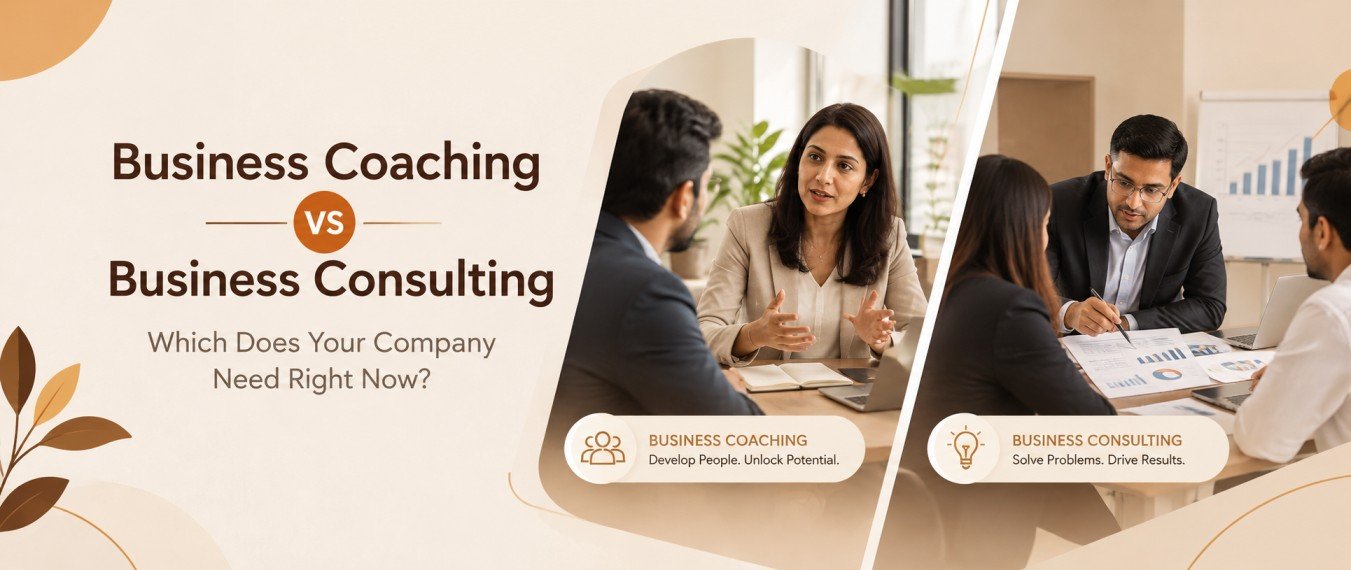

Founders in India rarely lack advice. They lack the right kind of advice at the right moment. Some pay for business coaching when a broken process is the real culprit, and others commission business consulting when the blockage sits in how they lead. Either mistake costs lakhs and a year.
If you know what to do but keep not doing it, you need business coaching. If you do not know what is broken or lack the skill to fix it, you need business consulting.
The rest of this guide tests that rule against real situations, with Indian examples and a checklist to use before you sign anything.
What Is Business Coaching?
Business coaching is a one-to-one or small-group relationship in which a trained coach helps a business owner clarify goals, test decisions and stay accountable to them. The coach asks questions and challenges assumptions. The owner does the work and owns the results.
Most founders already know a lot. The trouble is that nobody around them can say the uncomfortable thing. Family is too close, staff are too dependent and peers are busy, which is why business coaching in India has grown among founders.
What does a business coach do in a typical month of working with you?
Sessions usually run every one to two weeks. The first few go into business goals and vision: where the company should be in two years and what stops it. After that, the work becomes personalized guidance on live decisions, and each session ends with business strategy and action plans that carry dates.
Consider an illustrative case. A Gurugram distribution company has 40 staff, and the founder closes every large deal herself. Sales stalled, so she assumed the strategy was wrong. Three sessions showed the strategy was fine. She simply did not trust anyone else on a client call. Coaching made her say so, and she handed the next account to a senior manager.
Who gets the most from business coaching for small businesses in India, and who should look elsewhere?
- MSME founders who are the bottleneck in sales, hiring or approvals.
- Startup founders past the founder-led phase who now have to manage managers.
- Next-generation members of family firms preparing to take charge.
- CXOs and HR heads building leadership depth below them.
Look elsewhere if the gap is technical, such as a costing error, a plant layout or a missing system. Coaching will not build those for you.
Benefits of business coaching for small businesses, and the benefits of hiring a business coach beyond the obvious
- Clearer priorities, so the team finishes fewer things properly.
- A way to increase productivity without adding headcount.
- Executive training and mentorship for your second line of managers.
- A steadier route to overcome business challenges that come from habit rather than skill.
- Business mentorship and founder mentorship from someone with no stake in office politics.
Business owners who want to grow a business through coaching should pick one or two measurable goals first. A general wish to improve rarely survives a busy quarter.
Business coaching statistics and ROI: what the evidence supports and what it does not
A widely cited study by Manchester Inc. of 100 executives reported an average return of about 5.7 times the cost of coaching. Read it as a direction, not a promise. The figures were self-reported, the sample was small, and the study covered corporate leadership programs rather than Indian MSMEs.
For any return on investment (ROI) claim, ask which number will move in your business and how it will be measured.
Business coaching services for small businesses
A small business coach usually works with the owner and one or two senior people. Business coaching services for smaller companies tend to cover goal setting, time and priorities, hiring and delegation, pricing confidence, and executive training and mentorship for the next layer of managers. Because the owner is also the biggest variable in the business, even a modest shift in how they work shows up in the numbers fast.
What Is Business Consulting ?
Business consulting is a paid project in which an outside specialist studies your company, finds what is broken or missing, and recommends or builds the fix. It has a defined scope, a timeline and deliverables, and it ends when the work is handed over.
Its main value is distance. A business consultant has no history in your office and no loyalty to last year's decisions, so they can say what insiders avoid.
The five stages of a business consulting engagement, and what you should hold at the end of each
- Scoping: a written problem statement and a success measure.
- Diagnosis: interviews, data review and a root cause, not just symptoms.
- Options: two or three routes, each with cost and trade-offs.
- Build: the new process, price list or structure, with project management workflows your team can run.
- Handover: training, documents and a date when the consultant steps back.
If a proposal cannot name what you will hold at the end of each stage, push back before you sign.
Quick corrections and structural change: the two kinds of consulting work
Quick corrections include renegotiating supplier terms, fixing a pricing slab or adding a customer feedback loop. Your own managers could often do these. Pay a consultant for them only when nobody has the time.
Structural change is different. It means a new business model, a new market or a redesign of how work flows. This is where experience from other industries earns its fee. A queue-reduction method from auto-component plants, for instance, can shorten patient waiting in a diagnostic chain.
Strategic vs management consulting difference, explained with one example each
Strategic consulting answers where to compete. Should a Pune component supplier chase exports or defend its domestic customers first?
Management consulting answers how to run. Why does the same supplier lose three days between the shop floor and dispatch? That is an operational efficiency problem. If your question begins with "should we," ask for strategic consulting. If it begins with "why is it so slow," ask for management consulting.
Consulting firms, independent consultants and consulting business models compared
Ask which of these consulting business models you are buying before you compare quotes. Two fees can look equal and mean very different things.
Model | Best suited to | Watch out for |
| Large consulting firms | Multi-city projects with a board-level sponsor | Junior staff doing most of the work |
| Boutique firm | A defined problem in one domain | Thin range outside its speciality |
| Independent consultant | A focused problem needing one expert | Limited availability, no backup |
| Asset-based consulting | Faster delivery using reusable toolkits | Templates never adapted to your business |
Benefits of hiring a business consultant, and the honest limits
The benefits of hiring a business consultant, and of business consulting in general, are easiest to see against the alternative. Bringing on a full-time specialist costs a salary, benefits and months of ramp-up, and you may not need that person after the first year. Business consulting is usually more cost-effective for a one-time problem, and your internal team can keep running day-to-day operations while the project gets done.
Speed is the second gain. A consultant who has solved the same problem for other companies does not start from zero. Objectivity is the third, and it is underrated. People inside a company rarely tell the owner that the favourite product line is losing money. An outsider will.
- Speed: they have met similar problems before.
- Cost control: a project often costs less than a permanent senior hire you may not need next year.
- Objectivity: an outsider can tell you that a favourite product line is losing money.
- Focus: your team keeps running daily operations meanwhile.
The limit is durability. Once the consultant leaves, the habits that caused the problem can return, which is why many founders add coaching afterwards.
Business Coaching vs Business Consulting, Compared Side by Side and Problem by Problem
Question | Business coaching | Business consulting |
| Who supplies the answers? | You do, under questioning | The consultant, from expertise |
| Main focus | Decisions, habits, leadership | Strategy, processes, structure |
| Typical length | Months, with regular sessions | Weeks to months, fixed end |
| What you hold at the end | A sharper leader and an action plan | A diagnosis, a plan, often a built fix |
| Biggest risk | No technical answers | Old habits return after exit |
Coaching improves how you decide. Consulting improves what you are deciding about.
Five signs the real bottleneck is you, which points to business coaching
- Every decision of any size still lands on your desk.
- You know what must change but keep postponing it.
- You have nobody to talk to who is not staff, family or a competitor.
- You moved into a bigger role recently and are working it out as you go.
- Your goals change monthly, so the team never completes anything.
Five signs the real gap is knowledge or structure, which points to business consulting
- Margins are shrinking, and nobody can say why.
- You are entering a new city or product line for the first time.
- Processes that worked at 20 people are breaking at 80.
- You need new technology, and nobody in-house has adopted it before.
- You need a specialist for six months, not a full-time hire for six years.
How the choice plays out for Indian family businesses, factories and startups
- Family businesses: how to scale a family business in India often starts with consulting to fix roles and decision rights, as in family business advisory in Mumbai. Founder mentorship for the next generation follows.
- Factories: manufacturing unit consulting in Pune usually targets flow, rework, and supervisor skills. Coaching for the plant head comes later.
- Startups: business consulting services for startups in India, including business consulting for startups in Bangalore, cover pricing, hiring plans, and sales structure. Business coaching services in Delhi NCR often begin once the founder becomes the bottleneck.
When you need both, and which one to hire first
System broken: start with consulting, then add coaching so you can run the new setup without sliding back.
Owner is the constraint: start with coaching, then bring in a consultant for the project that finally has room to work.
Strategic business advisory sits between the two, for founders who want a senior outside voice on business growth strategy without a full project. The same logic applies to digital transformation: a consultant picks and builds the steps, and coaching keeps you steady while the team adapts.
Five questions to ask yourself, and four to ask any provider before you sign
- Can you state the problem in one sentence with a number? Lean towards consulting.
- Do you already know the answer and avoid acting on it? Lean towards coaching.
- Does the fix need knowledge your team lacks? Consulting.
- Would the problem return if the project ended tomorrow? That is a habit, so coaching.
- Do you need results in eight weeks, or change over a year? Short deadlines suit consulting.
- What will I hold in my hand at the end, and by when?
- Who will do the actual work, not just the pitch?
- Can I speak to two past clients directly?
- How will progress be measured, and who reviews it with me?
You may not need either yet. If the real problem is a missing hire or a cash gap, fix that first.
How Getting Roots Works, Including the Times We Tell Founders They Do Not Need Us
We have operated since 2012, with 4 lakh+ professionals impacted and 150+ certified trainers, facilitators, and consultants. We are a FranklinCovey Lifetime Community Member, and we run live programs, not recorded courses. Every engagement follows five steps.
- Discovery call: we hear the problem in your words.
- Needs assessment: we test whether coaching, consulting or neither fits.
- Custom design: the engagement is built around your goals.
- Delivery: live sessions or project work with your team.
- Impact measurement: results are checked against the goals set at the start.
Our business coaching work is aimed at business owners and leaders who want clearer priorities, stronger accountability and a team that can run without them in every meeting. Our business consulting work picks up when a specific strategy, structure or process needs an outside expert and a clear plan. We will also tell you if you need the other one first.
Frequently Asked Questions About Business Coaching and Business Consulting in India
What is business coaching?
Business coaching is a structured partnership between a trained coach and a business owner or leader. The coach asks questions, challenges assumptions and keeps you accountable to your goals. You create the plan and carry it out, which is why the gains tend to last after sessions end. It suits business owners who know the direction but struggle with execution, delegation or focus.
What is business consulting and how does it work?
Business consulting is a project-based engagement where an expert studies your company, diagnoses a specific problem and recommends or builds a solution. It usually moves through scoping, diagnosis, options, build and handover. The consultant brings specialist knowledge and an outside view, then leaves when the agreed deliverables are done. You pay for a defined result rather than open-ended support, which makes the cost easier to plan.
Can small businesses benefit from business coaching?
Yes. In a small company the owner is often the biggest bottleneck, so changes in how you delegate and decide show up quickly. A small business coach can help with focus, hiring and pricing confidence, usually at lower cost than a consulting project. The benefit is largest when you set one or two measurable goals at the start, such as a manager who can run a branch alone.
What is the difference between strategic and management consulting?
Strategic consulting deals with direction: which markets to enter, how to position yourself and what to charge. Management consulting deals with execution: processes, structure and operational efficiency. A founder asking "where should we compete?" needs strategy. One asking "why is delivery so slow?" needs management consulting. Many projects need both, usually in that order, because direction comes before process redesign, and a good proposal should say which one it covers.
Is business coaching worth the money?
It can be, when tied to specific, measurable goals. Research such as the Manchester Inc. study reports strong returns, though the figures are self-reported and come from executive programs. Your result depends on the match with your coach and how consistently you act on what you agree in sessions. Ask any provider how they will measure it before you commit a single rupee.
Conclusion: Pick the Problem First, Then the Person You Hire for Business Coaching or Business Consulting
Business coaching helps when you are the constraint. Business consulting helps when the company lacks a plan, a system or a skill. Many founders need one now and the other next year, and that is a normal path.
If you are still unsure, talk it through with people who have watched both succeed and fail. You can schedule a discovery call, phone +91-8505862222, or write to contact@gettingroots.com. Describe what is stuck, and we will tell you which one fits, even if the answer is neither.
• Join us on Facebook
• Connect on LinkedIn
• Follow us on Instagram
• Watch on YouTube